Laser Resurfacing · Newport News
Laser resurfacing in Newport News.
Sanding the damaged surface off, not painting over it — and telling you what the week afterwards actually looks like. Performed by the provider, not delegated, on Jefferson Avenue near Kiln Creek — and reachable from most of the Virginia Peninsula without crossing water or a tunnel.
Erbium:YAG ablative resurfacing on the Rohrer Spectrum, from a light peel through full-field resurfacing, with the depth chosen for your skin rather than picked from a menu. This page covers what it treats, how deep we would go and why, what healing is genuinely like, and what it costs.
What resurfacing actually does
Think of an old hardwood floor. Years of traffic leave it scuffed and uneven, and you do not fix that by painting over it — you sand off the damaged surface and let the fresh wood underneath become the new surface. Resurfacing is the sanding step.
Our laser is an erbium:YAG at 2,940 nm, which sits almost exactly on the peak of water’s absorption curve. Skin is mostly water, so the pulse is spent in a very thin slice: the surface layer is vaporized and very little heat is left in the tissue underneath. That is the whole reason we chose it — though not quite for the reason usually given. Matched depth for depth, erbium and CO₂ provoke pigment at about the same rate. What the wavelength buys is the ability to take a shallow slice without heat traveling deeper than the slice, so we treat shallower than a CO₂ resurfacing would go, and it is the shallower injury that lowers the pigment risk. Faster healing and shorter redness come with it. The trade is that it tightens less per pass than a hotter laser does.
How it works
Five steps, from why the number 2,940 was chosen to what the week afterward actually looks like.
Tuned to water.
Our laser is an erbium:YAG at 2,940 nm, and that number is the whole design. Water absorbs 2,940 nm harder than it absorbs anything else in this range — roughly 13 to 16 times harder than the 10,600 nm a CO₂ laser puts out. Skin is mostly water, so skin is what absorbs it. The vertical axis is logarithmic, which is the only way to fit both numbers into one picture; the bars underneath show the same two numbers in true proportion.
Spent in the top few microns.
Absorption that steep has one consequence that matters: the light itself only reaches a micron or three into tissue, so a pulse spends essentially all of its energy at the surface. Above about 1.6 J/cm² the water in that layer flashes to steam and carries the layer away, and every further J/cm² takes another two to four microns with it. One pass comes off at 10 to 40 microns — a fraction of an epidermis — and there is very little energy left over to travel downward as heat.
The heat you don’t remove.
Whatever is not vaporized but still got hot is the residual thermal damage zone, and it is where the two ablative lasers genuinely part company. More heat means more collagen contraction and less bleeding; it also means slower healing and longer redness. What it does not mean is that erbium is simply the safe one. Compared at matched depths of injury, the pigment complication rates come out similar — depth and heat raise that risk, not the name on the laser. The advantage is real, but it sits one step back: this wavelength makes a shallow slice achievable without heat reaching past it, so the treatment can be kept shallower — and that is what lowers the risk.
Depth is the whole decision.
Because erbium takes tissue a few tens of microns at a time, depth is set by how many passes we make, not by a different machine. A light peel stays superficial: less change per session, a shorter recovery, the option to stage. Full-field takes the whole surface and can go further for scars and etched-in lines, with a correspondingly longer recovery. Our laser has no fractional lens and we will not describe a capability we do not have. Stacking passes widens the heated band from the frame before, too, which is the other reason we would rather stage than push. The light peel across the full face is the one line you can book online; a single zone and full-field are arranged at the consultation.
Healing, described honestly.
Most people re-epithelialize in about five days. The first two to three days involve swelling and weeping; after that the skin is closed but pink — a few weeks after a lighter treatment, longer after a deeper one — and makeup is usually fine once it has closed. Sun protection during healing is not optional. The rest of what is on screen is the part that is easier to hear before a deposit than after.
Read it instead
1 · Tuned to water.
Erbium:YAG fires at 2,940 nm, which sits essentially on the peak of water’s absorption curve — roughly 13 to 16 times more strongly absorbed than the 10,600 nm of a CO₂ laser. Skin is mostly water, so skin is what absorbs it.
2 · Spent in the top few microns.
The light reaches only one to three microns into tissue, so a pulse spends its energy at the surface. Above about 1.6 J/cm² that water flashes to steam and the layer leaves; every further J/cm² takes another two to four microns. One pass comes off at 10 to 40 microns.
3 · The heat you don’t remove.
Erbium leaves a heated band of roughly 10 to 50 microns in short-pulse mode; CO₂ leaves roughly 50 to 150. More heat tightens more and bleeds less, but heals slower. At matched depths of injury the pigment complication rates come out similar, so depth and heat drive the risk, not the name of the laser.
4 · Depth is the whole decision.
Depth is set by how many passes, not by a different machine. A light peel stays superficial and can be staged; full-field takes the whole surface and can go further, with a longer recovery. Our laser has no fractional lens.
5 · Healing, described honestly.
Most people re-epithelialize in about five days, with swelling and weeping for the first two to three. Pinkness lasts weeks, longer after a deeper treatment. Sun protection is not optional. We refer out for laxity, for deep etched lines in fair skin where one session has to do it, and for deep rolling acne scars in fair skin. In darker skin we test-spot, go lighter and stage.
What it treats well
- Rough or uneven texture
- Fine lines, including etched lines around the mouth and eyes
- Photodamage — the accumulated surface damage of years of sun
- Shallow and moderate scarring
- Surface lesions, including actinic keratoses and benign lesions, treated with the same laser
Hands are treated too, and are priced on the hand rejuvenation page.
The periorbital zone is the single most-requested one. If the reason you are looking at resurfacing is that your under-eyes look tired, read the under-eye bags and dark circles page first — laser is the right answer for some causes of that and the wrong one for others.
Light peel, or full-field
Depth is the entire decision, and it is the one thing a price list cannot make for you. A light peel stays superficial: less change per session, a shorter recovery, and the option to stage. Full-field resurfacing takes the whole surface and can go further for scars and etched-in lines, with a correspondingly longer recovery.
Our laser has no fractional lens and we will not describe a capability we do not have. What we offer is a light peel through full-field resurfacing, with the depth targeted to your goals and to what your skin will tolerate. If you are between the two, that is a conversation at the consultation rather than a guess at booking. The light peel across the full face is the one line you can book online; a single zone and full-field resurfacing are arranged at the consultation, where depth and candidacy are decided together.
Healing, described honestly
This is a procedure with real downtime and we would rather you plan around it than be surprised by it. Most people re-epithelialize in about five days. The first two to three days involve swelling and weeping. After that the skin is closed but pink — a few weeks after a lighter treatment, longer after a deeper one — and makeup is usually fine once it has closed.
Sun protection during healing is not optional. New skin that is exposed to sun is how a good result turns into a pigment problem.
Resurfacing in darker skin
Erbium is the safer ablative choice in richly pigmented skin precisely because it leaves so little heat behind, and heat is what provokes pigment cells. That is a real advantage, not a marketing one.
It is not a guarantee. Depth matters more than the laser’s name, and a deep erbium treatment carries genuine darkening risk in any skin tone. We treat Fitzpatrick types IV–V with a conservative protocol, treat type VI with added caution, and test-spot and stage rather than chase a result in one session. We have written up which devices are safe in darker skin and which are not in more detail.
When we would send you elsewhere
We own an erbium and we do not own a CO₂, and pretending erbium does everything would be the kind of thing this practice exists to not do. We will refer you out when you have deep, etched lines around the mouth or eyes in fair skin and want the maximum change in one session; when your main concern is laxity rather than texture; or when you have deep, rolling acne scars in fair skin, where fractional CO₂ has the stronger track record.
In those cases a good fractional CO₂ in experienced hands is the better tool, and we would rather you got the better tool. The full comparison, with sources, is in erbium vs CO₂ laser resurfacing, explained.
Pricing
Consultations are free, and you will have the price of your plan before anything is booked. PRP is priced as an add-on to a resurfacing session — the figure below is added to the price of the resurfacing itself, not charged in place of it.
| Treatment | Price |
|---|---|
| Light Er:YAG peel — full face | $700 |
| Full-field Er:YAG resurfacing — full face | $1,200 |
| Er:YAG resurfacing — neck | $600 |
| Er:YAG resurfacing — neck and décolletage | $900 |
| PRP add-on — face only | +$250 |
| PRP add-on — face, neck and chest | +$500 |
Hand resurfacing is priced on the hand rejuvenation page and treatment of discrete actinic keratoses on the actinic keratosis page. Resurfacing is performed by the provider, not delegated.
Two manufacturer photographs of Er:YAG resurfacing
Both slides came from Rohrer Aesthetics, who build the Er:YAG our resurfacing runs on, and both show pigment rather than texture — the surface layer is taken off and the sun damage sitting in it goes with it. Neither slide states the depth that was used, so read them as what an erbium does to sun-damaged colour, not as a picture of any one line on the price list above.
-
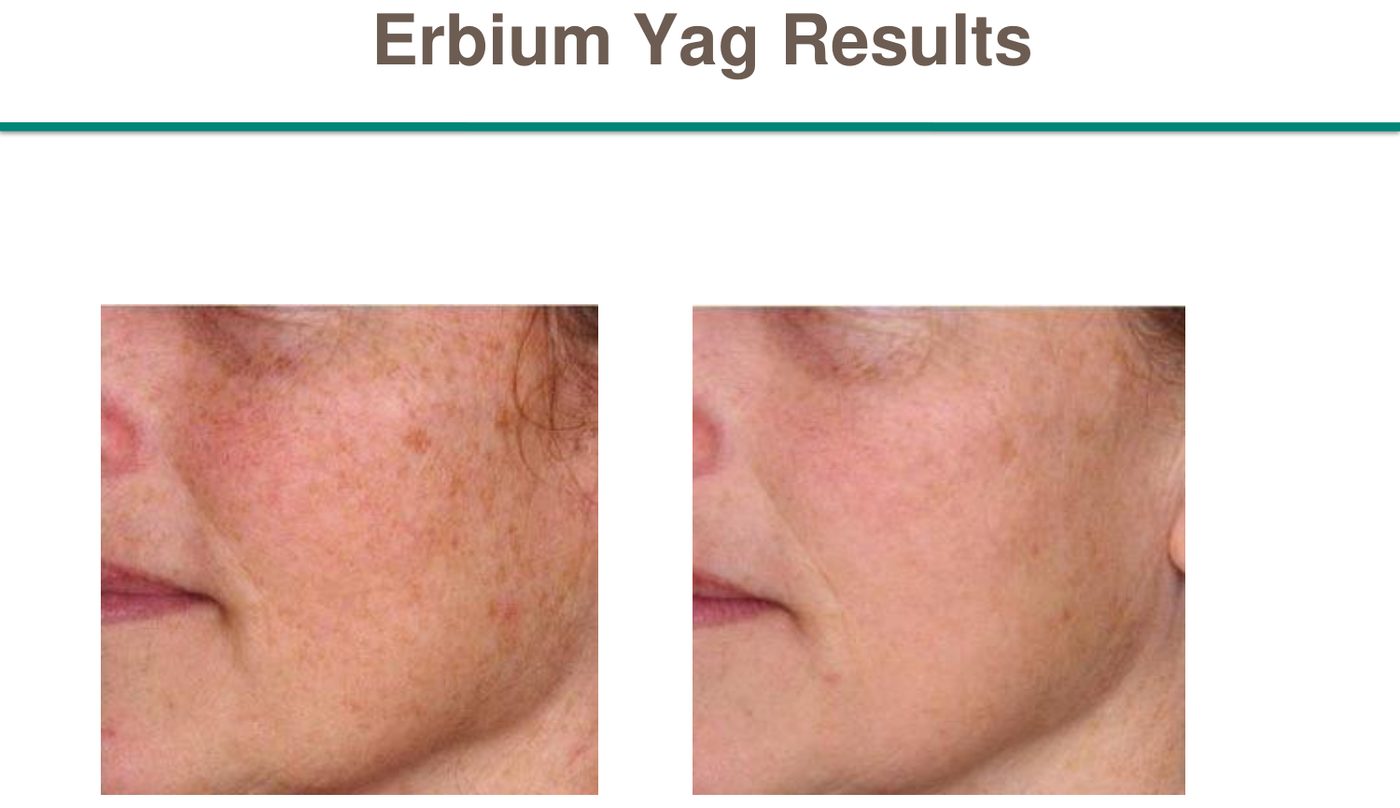
Freckling and brown spots over the cheek and jaw. Lighter and more even in the after frame, with the deeper spots still faintly visible.
Rohrer Aesthetics slide · no clinician credited · the manufacturer’s logo sits below the bottom edge of the file we were sent · not a patient of this practice
-
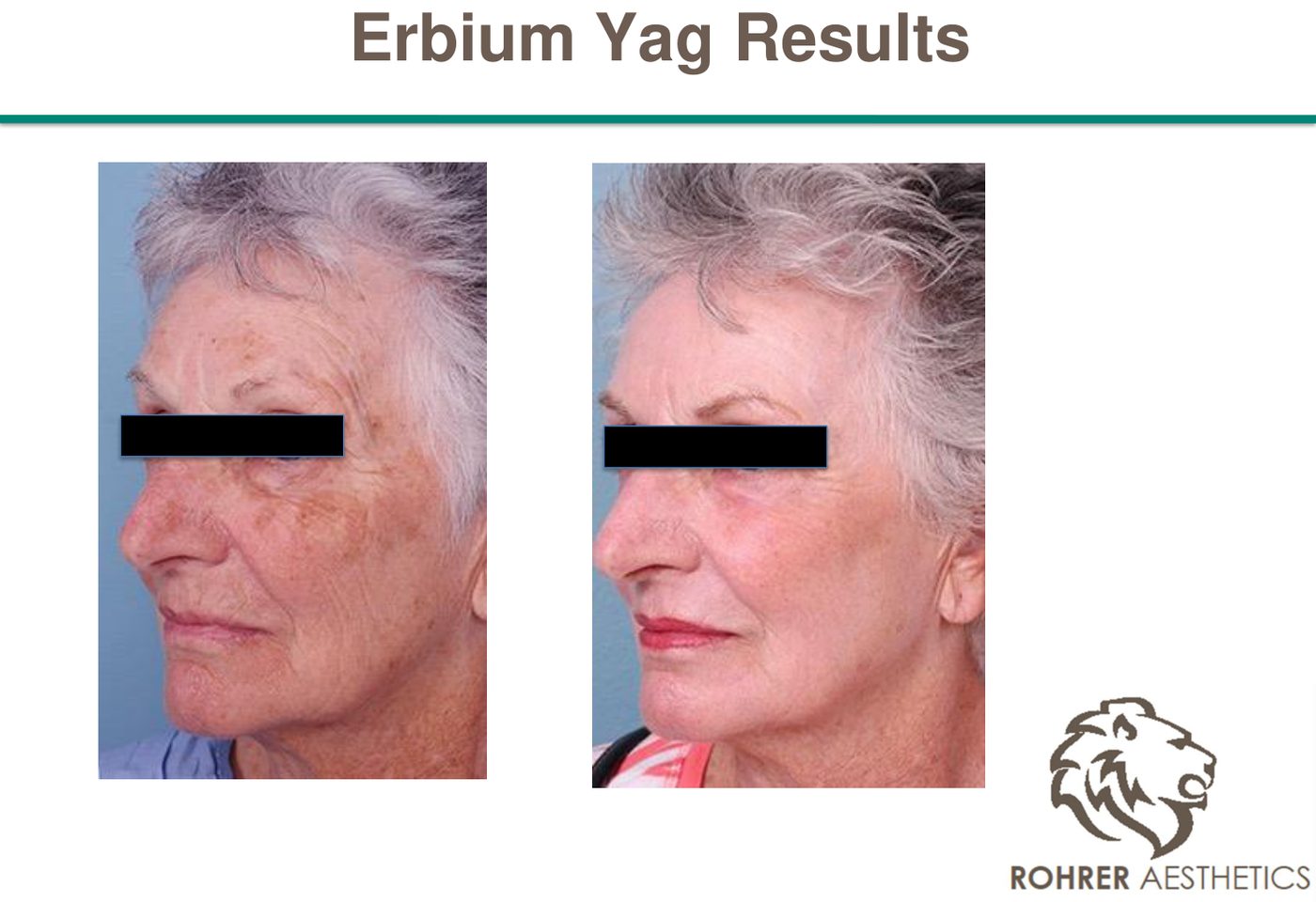
Broad patches of sun-damage pigment across the temple, cheek and jaw, lighter and more even in the after frame. The eyes are masked in both frames by the manufacturer, not by us.
Rohrer Aesthetics slide · no clinician credited · not a patient of this practice
Questions
What is laser resurfacing?
A controlled removal of the outer layer of skin so that newer, smoother skin heals in its place. The laser is tuned to a wavelength that water absorbs, so the water in the top layer of skin flashes to steam and carries that layer away. New surface skin grows back within about a week, and the dermis underneath lays down fresh collagen over the following months — which is why texture, fine lines, sun damage and shallow scars improve.
How much does laser resurfacing cost in Newport News?
Here, $700 for a light peel across the full face and $1,200 for full-field resurfacing of the full face; the neck is $600, the neck and décolletage together $900. PRP is an add-on to a resurfacing session rather than a session of its own: add $250 for the face, or $500 for face, neck and chest, on top of the resurfacing price. Depth is chosen at the consultation rather than at booking, and consultations are free.
How long is the downtime after laser resurfacing?
Most people re-epithelialize in about five days. Expect swelling and weeping for the first two to three days, then pinkness for a few weeks after lighter treatments and longer after deeper ones. Makeup is usually fine once the skin has closed.
Does laser resurfacing hurt?
Lighter treatments feel like hot pinpricks and are handled with topical numbing. Deeper treatments are more intense and we plan pain control accordingly. It is over quickly; a full face takes well under an hour.
Can laser resurfacing be done on darker skin?
Yes, for Fitzpatrick types IV–V with a conservative erbium protocol. Type VI is treated with added caution. Depth matters more than the laser's name — a deep treatment carries real darkening risk in any skin tone — which is why we test-spot, go lighter, and stage sessions. If we do not think we can treat you safely, we will say so and point you to a non-laser option instead.
How many sessions will I need?
One for surface lesions and light texture work. Two or three, spaced a month or more apart, for acne scars or deeper lines. We would rather stage than over-treat, especially in darker skin.
Two ways to book
Call us — no login needed
(757) 586-4575. Answered 24 hours a day, including evenings and Saturdays. Most people are booked in about a minute.
Book online
Pick your time on our scheduler. New patients set up a quick login at the last step — that's how you reschedule yourself later. When you're done you'll land back here on a Booking confirmed page.
Didn't reach the confirmation page? Then nothing was booked — give us a call and we'll take care of it.
Newport News · Virginia
Start with a consultation. It’s free.
The light peel across the full face can be booked online. Full-field resurfacing starts here instead, because the right depth and the right candidate cannot be decided from a menu. Bring your questions — if a lighter treatment or a different one would serve you better, we will say so.
Takes about a minute. You'll come back here to a confirmation page when you're booked — if you don't get there, call (757) 586-4575, any hour.