Spider Veins · Newport News
Leg spider vein treatment in Newport News.
Laser closes the small ones. And we’ll tell you when your veins need a different kind of doctor. Assessed on Jefferson Avenue in Newport News near Kiln Creek, with a vascular referral when that is the honest answer.
Spider veins are the fine red, purple, or blue threads that show up on thighs, calves, and ankles — retired capillaries that stopped carrying useful traffic but never got demolished. They’re almost always harmless. They’re also almost always unwelcome, and hiding them drives more wardrobe decisions than anyone admits.
We treat leg spider veins with a long-pulse Nd:YAG laser: a focused pulse heats the blood inside the vessel, the vessel wall seals shut, and over the following weeks your body reabsorbs it — a dead-end street getting closed and reclaimed, one street at a time. No needles, no injected chemicals, no compression contraption required for small areas.
How the laser closes a vessel
Five steps, start to finish — why 1,064 nm at all, what the pulse does to a vessel, and where this laser stops being the right tool.
First, get there.
A leg vessel sits in the dermis, under an epidermis full of melanin. Of the wavelengths used on vessels, 1,064 nm penetrates deepest and melanin absorbs it least — so the energy is still there when it arrives instead of being spent in the skin above. That single fact is also why it is the safer choice in darker skin: less of the pulse is taken by pigment that was never the target.
A weak target, taken whole.
Here is the part that sounds wrong. Hemoglobin barely absorbs 1,064 nm — call it two percent of what it takes at its 577 nm peak, and of the two forms it is oxyhemoglobin, not deoxyhemoglobin, that absorbs the more of it. It works anyway, for two reasons. At 577 nm the light is used up in the front thirty microns of the blood column; at 1,064 nm it crosses the whole vessel, so the whole blood-filled volume heats instead of one rim. And you make up the weak absorption with fluence — tens of times the energy density a pulsed dye laser uses. (The blood helps: as it coagulates, methemoglobin forms and its absorption at 1,064 climbs during the pulse.) This is the opposite of the IPL story, where a sharp short-wavelength peak does the work.
Wider vessels cool slower.
Heat leaves a vessel by diffusing outward, and diffusion time goes with the square of the distance it has to cross. Triple the diameter and the vessel holds its heat about nine times as long. So a fine facial capillary and a leg spider vein are not the same job: the pulse has to be long enough to cook the wall gently rather than burst it, and short enough to finish before the heat has spread into the skin around it. That is why pulse width is set from vessel caliber, not from a preset.
It seals, then it is carried away.
Inside the pulse, the blood column and the endothelium lining the wall heat together and the blood coagulates. The vessel contracts and closes — it is not vaporized, and nothing disappears while you are lying there. Over the next week or two the treated thread often looks darker or bruised, which is the closed vessel still sitting in the skin. Then your body resorbs it, over weeks to months. Judge it at twelve weeks, not two.
Where the laser stops.
Laser closes small-caliber surface vessels, and the ones it closes are gone. It does not touch the plumbing underneath. If your legs ache, swell or feel heavy, or the veins are bulging and ropy, the deeper system may be leaking backward — and treating the surface first is painting over the water stain while the pipe upstairs still drips. That is a vein specialist's ultrasound workup, and we refer rather than treat the surface first. Larger surface veins are usually a sclerotherapy job, which we don't offer and will tell you. Past that: most legs want two to three sessions about six weeks apart; the tendency that made the vessels doesn't go away, so new ones keep arriving; and fine new threads (matting) or a patch of darker pigment can follow any vein treatment, usually settling over a few months.
Read it instead
1 · First, get there.
A leg vessel sits in the dermis under a pigmented epidermis. Of the wavelengths used on vessels, 1,064 nm penetrates deepest and melanin absorbs it least, so energy reaches the vessel instead of being spent in the skin above. That is also why it is the safer choice in darker skin.
2 · A weak target, taken whole.
Hemoglobin absorbs 1,064 nm weakly — roughly two percent of what it absorbs at its 577 nm peak — and oxyhemoglobin, not deoxyhemoglobin, is the higher of the two there. It works because the target is a whole blood-filled volume rather than a thin rim, and because the weak absorption is made up with fluence and a long pulse.
3 · Wider vessels cool slower.
Heat leaves a vessel by diffusing outward, and that time goes with the square of the diameter. Triple the width and the vessel holds heat about nine times as long, so pulse width is set from vessel caliber.
4 · It seals, then it is carried away.
The blood column and the vessel lining heat together, the blood coagulates, the vessel contracts and closes. It is not vaporized. Treated threads often look darker for a week or two, then resorb over weeks to months. Judge at twelve weeks.
5 · Where the laser stops.
Laser closes small surface vessels and the ones it closes are gone, but it does not touch venous reflux underneath. Aching, swelling or ropy veins mean a vein specialist's ultrasound workup first, and we refer rather than treat the surface. Larger surface veins are usually a sclerotherapy job we don't offer. Most legs want two to three sessions about six weeks apart, the tendency that made the vessels keeps minting new ones, and matting or darker pigment can follow any vein treatment.
First, the honest map of vein treatment
Because “vein treatment” means three different things, and only one of them is ours:
Fine spider veins and small vessels — laser, here. This is where laser earns its keep: small-caliber vessels, ankle and foot vessels that are awkward for a needle, patients who’d rather not do injections, and the fine “matting” that sometimes follows other vein treatments.
Larger spider veins and reticular veins — often sclerotherapy, elsewhere. For bigger surface veins, sclerotherapy (injecting a solution that closes the vein) is the workhorse of the field and frequently the better tool. We don’t offer it, and if your legs are a sclerotherapy job, we’ll say exactly that at the consult and point you toward someone who offers it.
Bulging, ropy varicose veins — or legs that ache, swell, or feel heavy — vein specialist, full stop. Those symptoms suggest the deeper plumbing may be leaking backward (venous insufficiency), and treating the surface veins first is painting over the water stain while the pipe upstairs still drips. A vein specialist can check the deep system with ultrasound and fix the source; the cosmetic layer comes after. We’ll refer you rather than treat the surface first.
What treatment is like
A session takes 15–30 minutes depending on territory. Each pulse feels like a hot rubber-band snap — brief, tolerable, over quickly, with cooling the whole time. Treated vessels often look worse before better: darkened, bruised-looking for a week or two while your body does the reabsorbing. Fine vessels may clear in one visit; most legs want two to three sessions spaced about six weeks apart. Small area $350; sessions covering a larger area are quoted at your consultation.
Afterward: walking is encouraged the same day, hot tubs and hard leg workouts wait a couple of days, and sun protection on treated skin matters while it settles. We’ll tell you if your pattern would benefit from compression stockings for a few days — smaller treatments usually don’t need them.
Expectations, plainly: treated vessels are gone for good, but the tendency that made them isn’t. Genetics, standing careers, pregnancies, and hormones keep minting new ones over the years. Most people do a touch-up session every year or two and stay ahead of it.
Book the vessel you came in about
The same long-pulse Nd:YAG does more than one job, and our booking system lists those jobs as separate appointments so each one is scheduled for the right amount of time. Pick whichever matches what you want treated:
- Leg Spider Veins - Small Area — the fine leg threads this page is about. $350 a session.
- Facial Telangiectasias — the same laser aimed at individual broken capillaries on the face, most often across the nose and cheeks.
- Spider Angiomata (1-3) — the small red spots with fine vessels radiating out from a central point, booked as one to three lesions.
If you aren’t sure which of those you have, book whichever is closest and say so when you arrive; nothing is decided before we have looked, and the consultation is free. Facial redness that reads as a background flush rather than as vessels you can trace one by one is usually a rosacea conversation instead. Sessions covering a larger area of leg are quoted at the consultation rather than booked from this list.
Three manufacturer photographs of vessel work
All three slides came from Rohrer Aesthetics, who build the Spectrum platform, and all three were taken with the long-pulsed Nd:YAG at 1064 nm — the laser described above. The first shows leg veins; the other two show facial vessels, which is the same tool doing the same job somewhere else on the body. The rest of the manufacturer material we publish is on our before and after page.
-
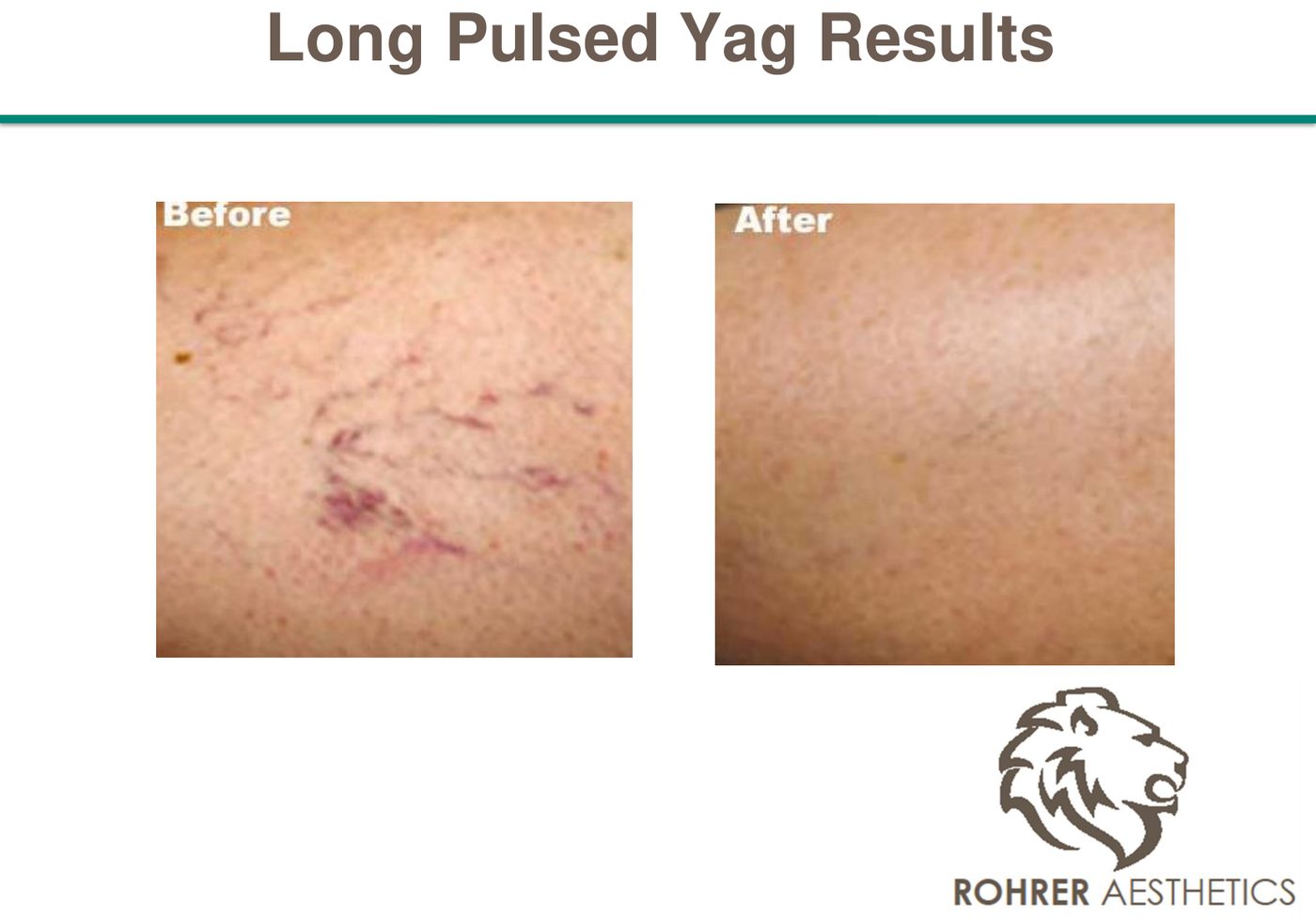
A cluster of fine red and purple leg veins, marked “Before” and “After” on the photographs themselves. The cluster is not visible in the after frame.
Rohrer Aesthetics slide · no clinician credited · not a patient of this practice
-
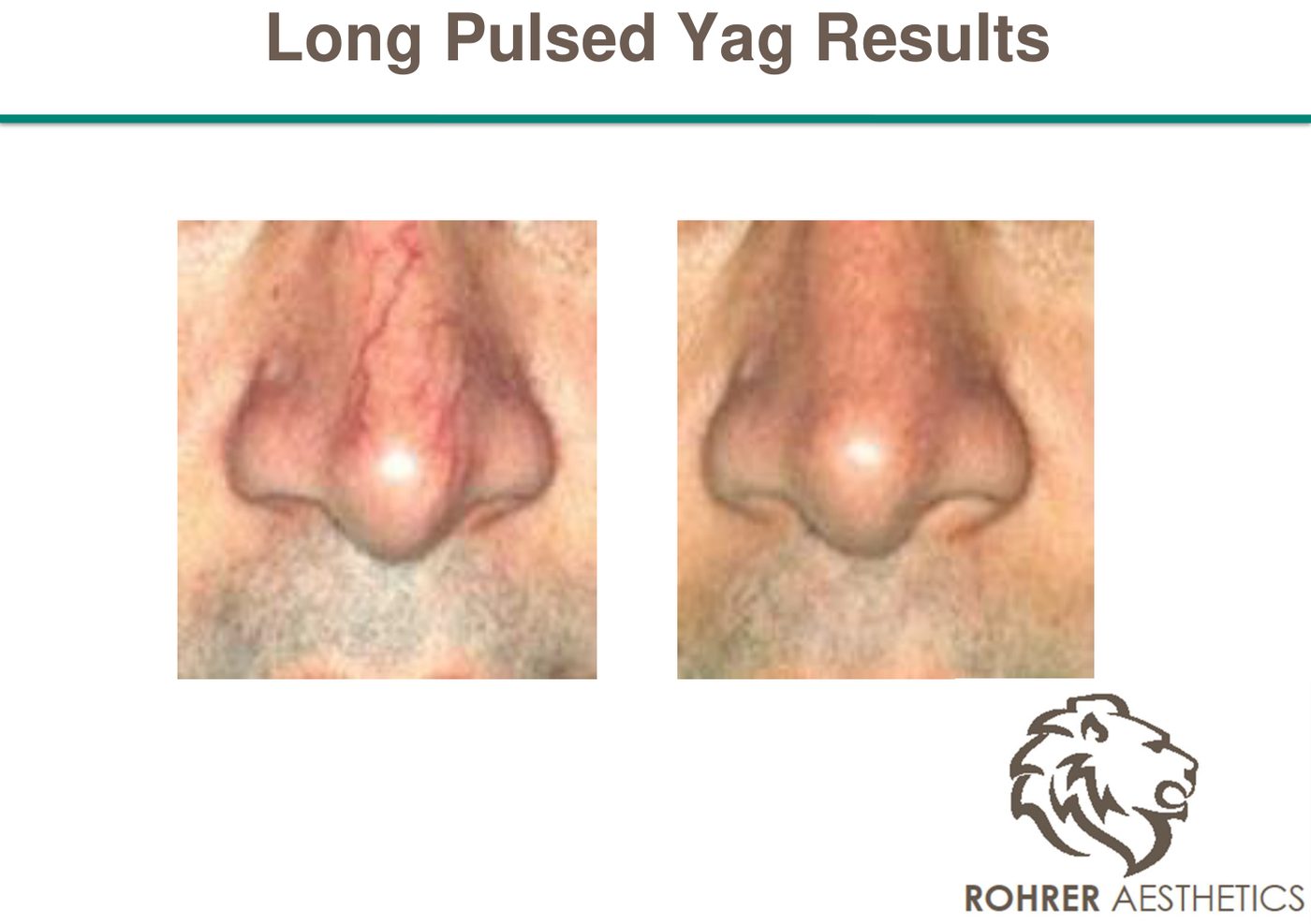
A single branching vessel running down the bridge of the nose. It is not visible in the after frame. The general pinkness of the nose is much the same in both.
Rohrer Aesthetics slide · no clinician credited · not a patient of this practice
-
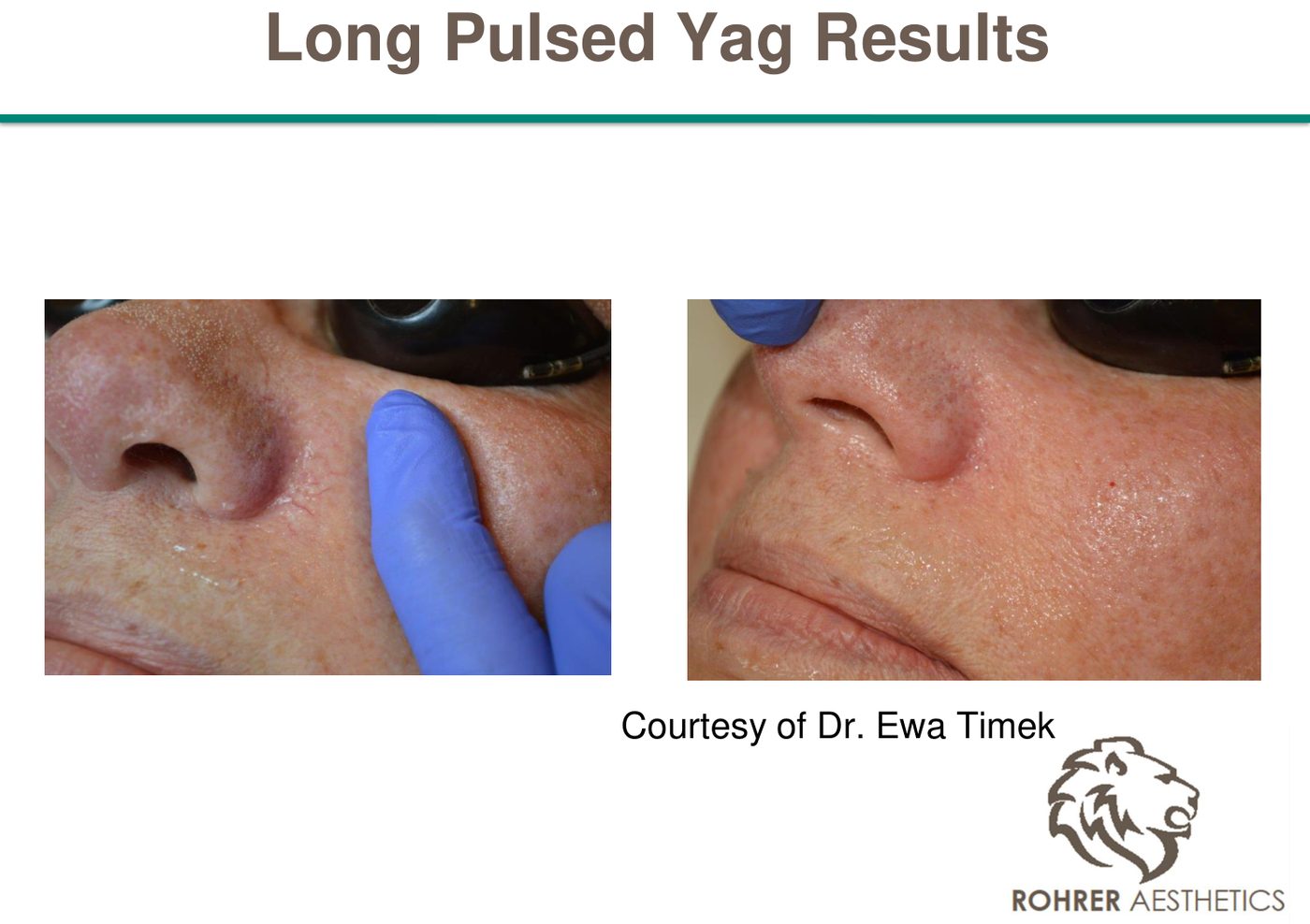
A purple vascular lesion on the rim of the nostril; a gloved hand steadies the skin in the before frame. The lesion is not present in the after frame.
Rohrer Aesthetics slide · courtesy of Dr. Ewa Timek · not a patient of this practice
Questions
What’s the difference between spider veins and varicose veins?
Spider veins are fine surface threads — cosmetic, flat, painless. Varicose veins are larger, raised, often rope-like, and can ache or swell; they usually signal a valve problem in the deeper leg veins. Laser here is for spider veins. Varicose veins need a vein specialist’s ultrasound workup first, and we refer for that.
Does laser actually work on leg spider veins?
Yes — for the right vessels. Long-pulse Nd:YAG closes small-caliber spider veins reliably over a short series. For larger surface veins, sclerotherapy is often the better tool, and we’ll tell you if that’s what your legs need instead.
How much does spider vein treatment cost in Newport News?
Here: $350 for a small area and $600 for comprehensive treatment of a larger territory, decided once we have seen it. Either way you get a per-session count estimate before anything is booked.
How many sessions will I need?
Fine, scattered vessels: sometimes one. Most legs: two to three sessions about six weeks apart, because vessels fade gradually as your body reabsorbs them. Judge results at twelve weeks, not two.
Do spider veins come back after laser?
The treated ones don’t — your body removes them entirely. New ones can form over time if you’re prone, so most patients plan an occasional maintenance session rather than expecting a permanent ceasefire.
Is there downtime?
Almost none. Walk out, drive home, work tomorrow. Expect the treated threads to look darker or bruised for a week or two, and skip hot tubs and heavy leg days briefly. We’ll tell you if your treatment pattern warrants compression stockings.
Two ways to book
Call us — no login needed
(757) 586-4575. Answered 24 hours a day, including evenings and Saturdays. Most people are booked in about a minute.
Book online
Pick your time on our scheduler. New patients set up a quick login at the last step — that's how you reschedule yourself later. When you're done you'll land back here on a Booking confirmed page.
Didn't reach the confirmation page? Then nothing was booked — give us a call and we'll take care of it.
Newport News · Virginia
Start with a consultation. It’s free.
Every plan here starts with a conversation. Bring your questions — we’ll give you a realistic picture of what each option can and can’t do, including when the answer is to wait or to start somewhere simpler.
Takes about a minute. You'll come back here to a confirmation page when you're booked — if you don't get there, call (757) 586-4575, any hour.